Money: a constructivist approach
When I was younger, I thought that money was cash.
In this view, if you went to a bank and deposited a dollar, at the end of the day, the dollar would be placed neatly next to a stack of gold bricks, in a vault deep beneath the bank. If you sent a wire, the dollar (or another like it) would be aboard an armored car the next day to the receiving bank. An armored plane if you paid for same day.
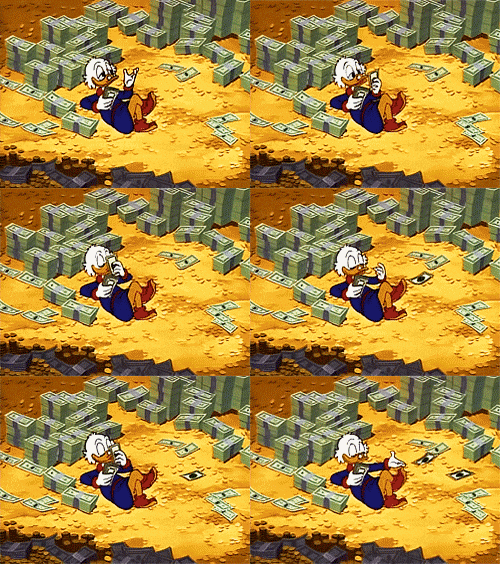
Of course, this mostly wrong. But, I suspect, that why this is wrong is not as obvious to many people. I might even wager that banks, payments, and money generally, are misunderstood by most people.
Like:
- What is money, if money is not cash?
- Or: How does a dollar get around, if not by armored car?
- And: What do banks do, if not hoard piles of gold in a vault?
To begin to answer these questions, and more, I invite you, dear reader, to close your eyes, and imagine a time before money, and allow us to invent money from scratch…
…
You are Boog.
You have recently invented Agriculture.
On paper (not yet invented), settling down and growing food was a great idea. But, you’re much busier than you expected, and your diet of oats has not been feeling great.
So, you ask Grob, your hunter-gather friend, for a slice of wooly mammoth.
“For Rock-god’s sake!” cries Grob. “This is the sixth time this rock-week. What’s in it for me?”
And so, you agree to exchange three bowls of oatmeal for a delicious mammoth-steak.
Thus, Commerce is born (and Altruism begins its slow decline).
Things are going well. Your oat fields grow large and bountiful. Others settle down near you for oats. You exchange oats for Goods and Services. Eventually, enough people settle down, creating Civilization.
Problems quickly emerge.
You are sick and tired of oats. You happily trade vast sums of oats for modern indulgences like Clothing, Bronze, and Stone Tablets.
But oats have become so commonplace that the oat-rate for these luxuries has reached the hundreds, even thousands, of bushels (this is called Inflation). This is too much for you to carry around, and far too many oats for anyone to eat at once.
Of course, you are Clever, so you devise a Genius Scheme: instead of sending buschels of oats directly, you mark down on a clay tablet how many oats you owe to who in a ledger (in doing so, you invent Numbers and Writing). Oat creditors can redeem their oats as needed in smaller, more consumable quantities. The oats remain safe and dry in a warehouse.
You figure out that you can even gamble and plant the still unclaimed oats to have even more for next year.
The system is pretty good.
So good, that instead of redeeming the oats, people trade by asking you to move oats from their oat-account to another’s. It works so well that soon everything is priced in oats, even as fewer and fewer people are redeeming numerical-oats for real-oats.
This is called: the Money of Account.
To make it you don’t need to be involved in every transaction, you design an oat-redemption-token. Made of pocketable circles of Bronze equal the to value of redeemable oats, you emblazon it with your oat-seal.
“This is a Circular Oat Ingot Note,” you say, holding up a bronze loop, showing it around. “COIN for short. You can use this as a Unit of Exchange. Now please stop bothering me.”
And this is called: Cash.
Okay, we’ve been having too much fun. Let’s break down what we’ve discovered:
- Money can be a number, like “money of account”.
- Money can be a thing, like cash (or oats).
And, in fact, a number is much more portable than a thing.